
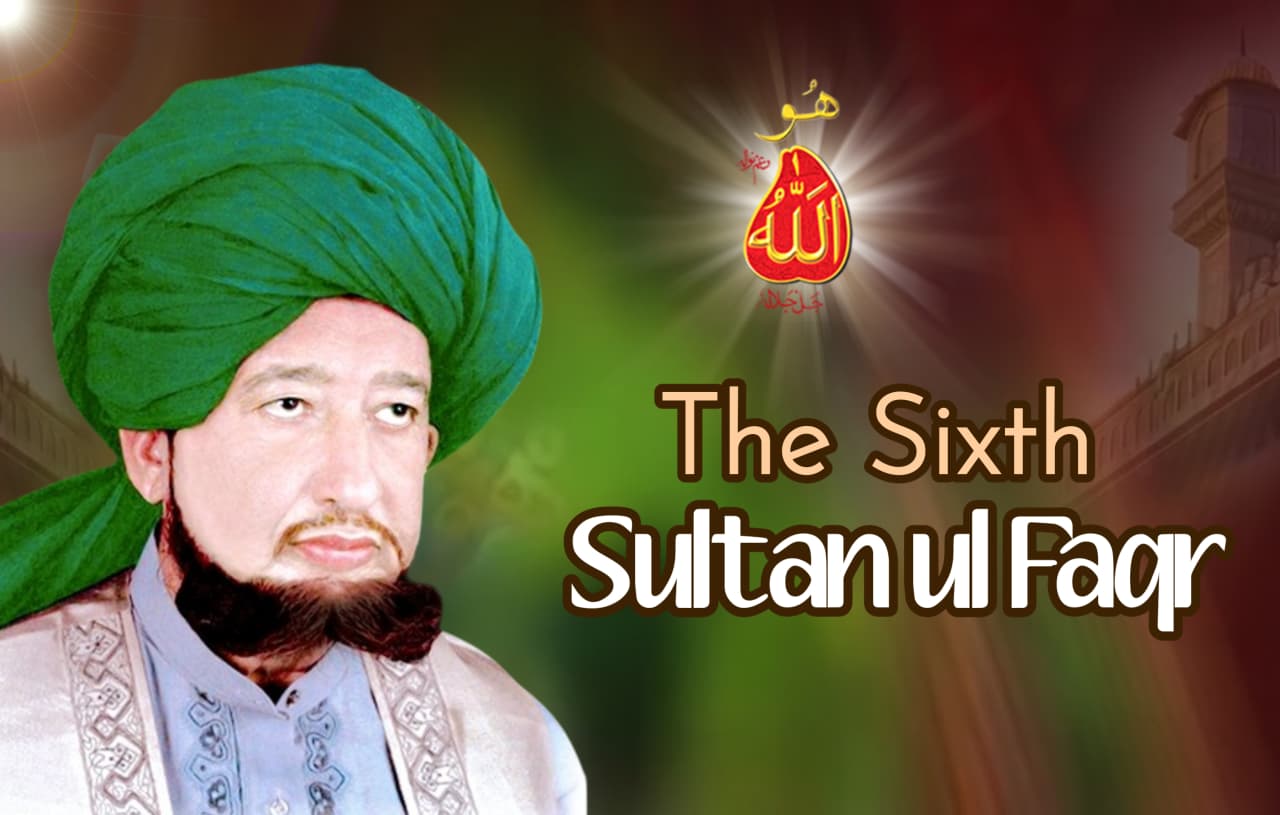
WHO IS SULTAN-UL-FAQR VII
SULTAN MOHAMMAD NAJIB-UR-REHMAN
The Spiritual Station, Teachings & Legacy of Faqr
Who is Sultan-ul-Faqr VII Sultan Mohammad Najib-ur-Rehman, and what can his life and teachings reveal about the true path of Faqr? This article offers a deeper look into the spiritual station, teachings, and profound devotion of Sultan-ul-Faqr VII.
At the heart of his teachings is Raza-e-Elahi, the complete acceptance of the will and pleasure of Allah. His life reflects a deep state of submission, Divine Love, patience, and devotion. He teaches seekers to rise above the desires of the self (nafs) and dedicate themselves sincerely to the Beloved.
The article explores the spiritual qualities of Sultan-ul-Faqr VII and the significance of his connection with the legacy of Faqr. It highlights his teachings on seeking Allah, enduring the trials of the spiritual path, and remaining steadfast through every hardship. For the true seeker, difficulties are not simply obstacles, They can become a means of purification and a way toward greater closeness to Allah.
The article also sheds light on the relationship between the seeker and the Murshid. Through spiritual guidance, a disciple can learn to transform pain into patience, patience into gratitude, and submission into true Raza. The teachings associated with Sultan-ul-Faqr VII provide valuable insight into this inward journey.
If you wish to learn more about Sultan-ul-Faqr VII Hazrat Sakhi Sultan Mohammad Najib-ur-Rehman, his spiritual teachings, and the deeper meaning of Raza-e-Elahi and Faqr, this article offers an opportunity to explore his message in greater depth.
Read the complete article to discover the spiritual wisdom of Sultan-ul-Faqr VII and understand how Divine Love, submission, patience, and devotion can transform the inward of a seeker.
The Sixth Sultan-ul-Faqr
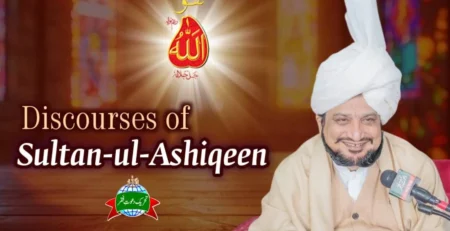
Sultan-ul-Ashiqeen Sultan Mohammad Najib-ur-Rehman
Allah says:
“O believers! Be God-conscious and have faith in His Messenger (blessings and peace be upon him). He will grant you a double share of His mercy, provide light to help you walk (in this world and the Hereafter) and forgive you. Allah is Most-Forgiving, All-Merciful.”
(Al-Hadid: 28)
The aforementioned verse indicates that Allah will bestow upon you a light by which you will walk. This refers to a light which signifies that even when the physical presence of the Prophet Mohammad is no longer manifest, his inward and spiritual form will continue to exist in the form of this light. Through this light, the paths of guidance will remain open for all of humanity.
This refers to the Universal Divine Man (al-Insan al-Kamil) who is the vicegerent of the Prophet Mohammad and the Imam of the Age. He is the inheritor of the Prophetic legacy and honor, and is the perfect and accomplished Spiritual Guide.
A blessed Hadith states that Abu Hurairah narrated that the Messenger of Allah said:
“Indeed, Allah will raise for this Ummah, at the beginning or end of every century, someone who will renew its religion for it.”
(Sunan Abi Dawud, 4291)
The Heirs of the Prophetic Legacy
Those who renew the religion and those who are the heirs of Mustafa (peace be upon him) are the ones who inherit his spiritual legacy, Faqr, and carry his method. They are capable of spiritually training the seekers of Allah in the same manner in which the Holy Prophet trained his Companions and showed them the path of the Straight Way.
The Holy Prophet Mohammad stated that without the permission of the Holy Prophet, the Divine Trust of Faqr cannot be transferred to any person.
The Treasure of Faqr was transferred from the Holy Prophet to the Lady of Paradise, Fatima al-Zahra, and she is the first Sultan-ul-Faqr in the Ummah of Mohammad. Ali bin Abi Talib, may Allah honor his countenance, inherited Faqr from the Holy Prophet, and through him Faqr was transmitted to the Ummah. Therefore, he is the Imam of Faqr.
This spiritual inheritance was then transmitted from one successor to another until it reached Shaikh Abdul Qadir Jilani, known as Ghaus-ul-Azam, the Sultan of Faqr.
Whenever the Divine Trust is to be transferred, the Holy Prophet entrusts that person to Ghaus-ul-Azam, Shaikh Abdul Qadir Jilani. From there, the person must present himself in the court of Sultan ul Arifeen Sakhi Sultan Bahoo to receive the Divine Trust or the Treasure of Faqr. From there, it is conveyed to the perfect spiritual guide of the Era.
Until the Day of Judgment, this treasure will continue to be transferred in the same order, with the permission and seal of its Mukhtar-e-Kul, the Possessor of the Divine Authority, the Master of the Universe.

Unique Spiritual Status of Sultan-ul-Ashiqeen
As has already been explained to the readers, the Treasure of Faqr, or the Divine Trust (Amanat-e-Elahia), is transmitted by the permission of the Master of both worlds, Prophet Mohammad. How the Divine Trust was transmitted to Sultan-ul-Ashiqeen and why his spiritual affair was distinct and exceptional from that of other disciples is a matter worthy of contemplation.
To shed light upon this matter, the account of a disciple of the spiritual guide of Sultan-ul-Ashiqeen, Sultan-ul-Faqr VI, Sultan Mohammad Asghar Ali, is presented here.
One of the disciples of Sultan Mohammad Asghar Ali was Sajid Hussain, who belonged to Dina and was residing in Lahore. Between August 2003 and November 2003, he saw the same dream three times. He mentioned this dream during his journeys and on numerous occasions during his meetings with others. The dream was as follows:
“I see that a gathering of my revered Murshid is taking place, and many people are present. My revered Murshid is seated and says:
‘Throughout our entire lifetime, we have selected thirty-two or thirty-three companions, who have fulfilled our standard.’
At this, Najib stands up. My revered Murshid looks towards him and says:
‘Brother Najib-ur-Rehman, you are not among these people. Your spiritual affair is separate and distinctive from theirs.’”
(The Spiritual Guides of Sarwari Qadri Order)
The Distinctive Spiritual Affair
Now, as to how this spiritual affair was distinct and exceptional, a brief account is presented here.
After Sultan-ul-Faqr VI, Mohammad Asghar Ali, had thoroughly examined and recognized the heir to the Divine Trust, he intended to undertake Hajj. On Wednesday, 28 February 2001, he departed for Hajj accompanied by nine selected seekers of the Lord and three women.
After performing Hajj, he arrived in Madina on 18 March 2001. On 21 March 2001, after paying his respects at the Sacred Chamber of the Messenger, while staying near Bab-e-Jibril, Sultan-ul-Faqr VI looked directly into the eyes of Sultan-ul-Faqr VII Sultan Mohammad Najib-ur-Rehman, and said:
“I have found the confidant of my heart.”
The Confidant of the Heart
Who is the confidant of the heart? There is a consensus among all the Sufi orders that the confidant of the heart is that seeker or disciple whom the Murshid chooses, after himself, to become the head or Imam of the spiritual order. It should be remembered that here we are speaking specifically of the transmission of the spiritual inheritance.
Khilafat, or succession to the spiritual seat, is an outward responsibility. However, the confidant of the heart refers purely to spiritual inheritance. Since the supreme Murshid of the Sarwari order is the bearer of the Divine Trust, the disciple to whom the Murshid transmits the Divine Trust or Faqr is regarded as the confidant of his heart.
Thus, on this very Hajj journey, the Divine Trust had already been transmitted inwardly to Sultan-ul-Ashiqeen. It was through the permission of the Master of Both Worlds, Prophet Mohammad, that the Treasure of Faqr, or the Divine Trust, was transmitted to Sultan-ul-Ashiqeen.
The Title of Shabeeh-e-Ghaus-e-Azam
As an honor for his efforts to breathe new life into the religion of Mohammad and to spread the reality of Faqr throughout the world, the title Shabeeh-e-Ghaus-e-Azam was bestowed upon him, may his exalted spiritual station endure, by the Mohammadan Assembly. This disclosure was spiritually manifested to his disciples in the form of spiritual struggles and experiences during the death anniversary (Urs) of Sayyid Abdullah Shah Madni Jilani in 2016.
The bestowal of the title Shabeeh-e-Ghaus-e-Azam serves as testimony that the one who receives this title is not only the Imam and true heir of Faqr, but also possesses an exalted spiritual station comparable to that of Al-Ghawth al-Azam.
Undoubtedly, this exalted station is attributed to the spiritual connection and relationship with Al-Ghawth al-Azam. The fact that this title was bestowed upon him, may his exalted spiritual station endure, by the Mohammadan Assembly clearly signifies that his inward spiritual insight is in accordance with that of the supreme helper, Al-Ghawth al-Azam.
Translation: The word of Allah has been fulfilled, the Divine secret is hidden from the world safe inside the heart. Do not judge it just by looking at it as this is the Divine treasure only granted to the chosen few who are spiritually elevated. Although it is difficult to express it in words but it is worth a try if it gets accepted by the Divine court. When the veil lifts up from the Divine light, the secret will be revealed. It is where all secrets are hidden behind veils.
The Rank and Spiritual Authority of the Perfect Fakir
Al-Ghawth al-Azam Abdul Qadir Jilani, regarding the Perfect Fakir and his spiritual authority (Tasarruf), states:
“When the heart of a servant reaches his Lord, Allah makes him independent of the creation and grants him His nearness. He makes him a sovereign possessing authority and says to him: ‘You possess power and are trustworthy in My presence.’
Allah makes him His successor in a realm, in command, and in the administration of the affairs and means of His kingdom, and makes him the trustee of His treasures.
Similarly, when the inward becomes sound, its nobility and purity become manifest through its detachment from everything other than Allah. Allah then grants him authority over the inwards of His creation and bestows upon him sovereignty in His dominion, both in this world and the Hereafter.
Thus, he becomes the Kaaba of his disciples for centuries, and they are drawn towards him in multitudes, coming to him from every direction.”
The rank and station of the Perfect Fakir are the highest and most distinctive of all. He is the Fakir who holds the power to do anything and who possesses the station of Fana-fi-Allah (annihilation in Allah) and Baqa-bi-Allah (remaining in Allah). All the treasures of Allah are placed within his power, and every particle of creation, everything beneath the heavens and the earth, and every created being is subject to his command.
It is for this reason that, during the spiritual ascension of Al-Ghawth al-Azam, Allah said to him:
“O Ghawth-ul-Azam, a Fakir is not one who possesses nothing. Rather, a Fakir is one whose command is effective over everything. When he says to a thing, ‘Kun,’ it comes into being.”
Sultan-ul-Ashiqeen is an embodiment of complete submission and contentment with the Divine Will.
Allah Almighty states in Surah An-Nisa, 4:125:
“And who can be better in religion than the one who submits himself entirely to Allah, and he is a doer of good…”
He further states in Surah Al-Baqarah, 2:112:
“Yes, whoever submits himself entirely to Allah and is a doer of good, his reward is with his Lord. No fear shall come upon them, nor shall they grieve.”
Tasleem-o-Raza: The Way of the Prophets
Tasleem-o-Raza is the Sunnah of the Prophets. For the sake of Allah’s decision, Prophet Ibrahim was prepared to sacrifice his beloved son. The highest example of Tasleem-o-Raza was established by the beloved grandson of the Beloved of Allah, Mohammad, in the plains of Karbala.
In the same manner, the perfect Fakirs, despite possessing everything within their spiritual power, adopt utmost humility, just as the Prophets, despite possessing spiritual authority over all things, remained humble before Allah. This humility is likewise bestowed upon the leader of his time because the station and rank that a Fakir receives through spiritual inheritance from the Holy Prophet are accompanied by the inheritance of submission to the Divine will.
Shaikh Abdul Qadir Jilani states:
“Whoever remains patient and content with Allah Almighty concerning His Divine Decree and Qadr, Allah Almighty grants him countless forms of help in this world and countless blessings in the Hereafter.”
The Essence of Raza-e-Ilahi
Sakhi Sultan Bahoo states:
“Those who worship their own selves can never attain Allah, because their self itself becomes their god. Allah is attained by those who, for the sake of submission to the Divine will, struggle against their own lives and keep their self under control.”
Sultan-ul-Faqr VI, Sultan Mohammad Asghar Ali, once spoke about himself:
“We have never asked Allah Almighty for anything except His vision and His will.”
On one occasion, he described his true heir in these words:
“The example of Brother Najib is such that he has completely bowed his head in submission to whatever pleases the Beloved.”
What Is Love?
What is love? Say that it is to become the slave of the Beloved, to place your heart in someone else’s hands and then remain bewildered and restless yourself.
Allama Iqbal says that Faqr is the state of experiencing love and longing, as well as submission to the Divine will. It is the treasure of Prophet Mohammad peace be upon him, and we are its trustees.
Whether it is the hardships endured in the search for the Truth, the trials faced by the seeker of the Lord, or the station of renunciation and the inheritors of Faqr, Allah Almighty says regarding them:
“Allah is pleased with them, and they are pleased with Allah.”
(Surah Al-Ma’idah, 5:119)
And:
“And Allah loves those who are patient.”
(Surah Aal-e-Imran, 3:146)
It is evident from the gatherings of the disciples that despite possessing immense inward spiritual powers, you live according to the will and command of Allah, the Lord of Majesty, and also encourage others to do the same.
Along with guidance and instruction, you cast an inward spiritual gaze upon the heart of the disciple in such a manner that, for the disciple, patience in every hardship is transformed into gratitude.
Sultan-ul-Arifeen Sultan Bahoo, while describing the Fakir in his Punjabi Abyat, states:
No matter how limited the apparent means may be or how difficult and strained the circumstances become, the true seekers of the Lord do not remain hesitant or fearful. Like skilled horsemen mounted on thoroughbred horses, they enter the battlefield of Divine Love with great courage and play the game of love to its fullest.
In other words, they place everything they possess at stake and attain the precious jewel of Truth.
Their state is such that they possess the rank of being beloved. Wherever they turn their gaze, a commotion arises.
In the final verse, he expresses sorrow over the condition of those who fail to keep their Murshid pleased. By displeasing their Murshid, they bring humiliation upon themselves and ultimately remain deprived of union with Allah Almighty.
Leave a Reply