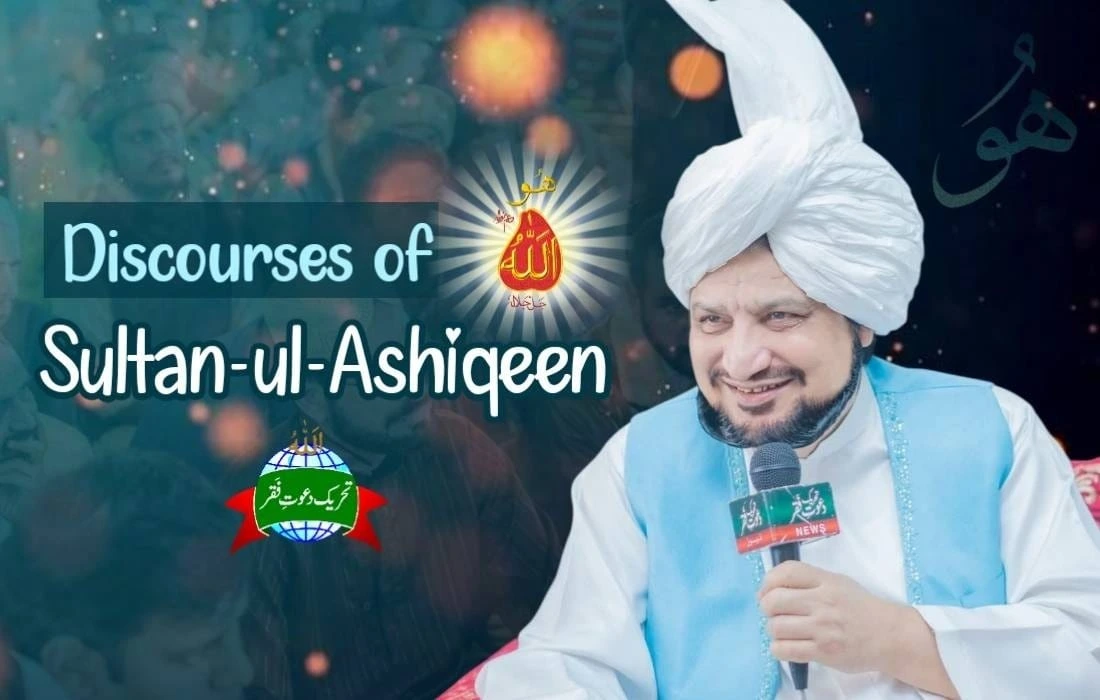
Discourses of Sultan-ul-Ashiqeen
Part 12
20th MAR, 2026
The Beginning of Idolatry
Sultan-ul-Ashiqeen said, “When the Prophet departed from this world, his followers made an idol of him. This is how idolatry began.”
Trial of the Beloved
Sultan-ul-Ashiqeen said, “The closer Allah brings someone to Himself, the more He tests him. Imam Hasan was poisoned, and the martyrdom of Imam Husayn is before you; all this happened because they were beloved to Allah. In the Quran, Allah says: اِنَّ الَّذِیْنَ قَالُوْا رَبُّنَا اللّٰہُ ثُمَّ اسْتَقَامُوْا (Surah Fussilat 41:30)
Meaning: Indeed, those who say: ‘Our Lord is Allah,’ and then remain steadfast.
It is only through trials that it is revealed who remained steadfast. Allah put Prophet Abraham through the trial of sacrificing his son, but then He did not take the sacrifice. It is Allah who is the Master and it is His will; sometimes He takes the sacrifice, like the sacrifice of Imam Husayn, and sometimes He does not, like the sacrifice of Prophet Ishmael.”
Faqr
Sultan-ul-Ashiqeen said, “Sultan Bahoo states in Jamia-ul-Asrar, ‘The Holy Prophet closely met Sultan-ul-Faqr in the court of Allah on the night of Miraj and embraced Faqr. Then the essence of the Holy Prophet itself transformed into Faqr.’”
Change in the System of Faqr
When Usman Ghani was martyred, the people of Faqr stepped to one side, and the rest to the other. Amir Muawiyah went to one side, and Hazrat Ali to the other.
Dreams of the Seeker
Sultan-ul-Ashiqeen said, “If the spiritual guide is perfect, and if he wishes, he can make the seeker pass through the outward difficulties destined for him within a dream.”
Striving for the World
Someone asked if one should strive for the world?
Sultan-ul-Ashiqeen responded, “When the world (wealth) comes, it causes disputes; when it increases, it is a source of mischief; and when it leaves, it again causes disputes. All those who claimed divinity were people of wealth and the world; just look at Pharaoh. If Abu Jahl did not possess worldly wealth, he would not have been Abu Jahl. It was only because of having the world that he went against the Holy Prophet to such an extent that he became known as Abu Jahl (Father of Ignorance) from Abu al-Hakim (Father of Wisdom).”
Method of Governance
A discussion started on how government officials should run the government.
Sultan-ul-Ashiqeen said, “A government is successful when it holds awe and authority. If the awe vanishes, the government’s control is lost. Awe is the real thing. Instead of using the law everywhere, it is better to instil fear. The public follows in the footsteps of their ruler. If the ruler becomes a role model, the public will also follow him. Aisha bint Abi Bakr narrated that when a woman committed theft during the time of the Messenger; Prophet Mohammad said that the Bani Israel were destroyed by similar things; when someone from the upper class among them stole, they would let him go, and if someone from the lower class stole, they would cut off his hand. This also happens in Pakistan; if a rich person commits a crime, he is forgiven, and if a poor person commits a crime, he is sent to jail. Now, if anyone commits the acts that destroyed Bani Israel, they too will be destroyed. The principles of nature do not change; they are for everyone. Whichever nation breaks these principles will meet the same fate as Bani Israel.”
How Does a Nation Progress?
Someone asked how a nation can be successful?
Sultan-ul-Ashiqeen said, “If a single shopkeeper is not honest, the entire market cannot be right. A market is made up of shopkeepers. Now, if the basic unit itself is not right, whatever is built from that unit will not be right. Therefore, until a nation is fixed from the bottom, it will not be fixed from the top.”
How Can Hearts Be Changed?
Sultan-ul-Ashiqeen said:
Hearts cannot be changed by force; hearts cannot be changed through fear and dread. Allah says in the Quran:
اِنَّ اللّٰہَ لَا یُغَیِّرُ مَا بِقَوْمٍ حَتّٰی یُغَیِّرُوْا مَا بِاَنْفُسِہِمْ (Surah Ar-Ra’d 13:11)
Meaning: Indeed, Allah never changes the condition of a people until they change it themselves.
Allama Iqbal says:
نہ ہو جس کو خیال آپ اپنی حالت کے بدلنے ک
Meaning: God has never changed the condition of that nation, which does not think of changing its own condition.
Selling Religion for Money
Sultan-ul-Ashiqeen said:
Jewish scholars used to sell religion for money. Whoever gave them money, they would mould the verdict according to their wishes. Allah says:
اِنَّ الَّذِیْنَ یَکْتُمُوْنَ مَآ اَنْزَلْنَا مِنَ الْبَیِّنٰتِ وَ الْہُدٰی (Surah Al-Baqarah 2:159)
Meaning: Indeed, those who conceal the clear proofs and the guidance that We have revealed.
The Messenger of Allah said, “He who conceals the truth is a mute devil.”
When Abdullah ibn Salam heard about the arrival of the Messenger of Allah, he immediately presented himself before the Holy Prophet and submitted, “I ask you three questions which only a Prophet knows...”
The Prophet answered all these questions through Divine revelation brought by Angel Gabriel.
Hearing this, Abdullah ibn Salam declared, “I bear witness that there is no god but Allah, and indeed, you are the Messenger of Allah.”
He then requested the Prophet to ask the Jews about his status before revealing his conversion, knowing they were great slanderers.
The Jews praised Abdullah ibn Salam highly until they learned he accepted Islam, after which they immediately called him ‘the worst among them’.
Abdullah ibn Salam submitted, “O Messenger of Allah! This is exactly what I feared.”
When the Messenger of Allah migrated and arrived in Madina, the father of Safiyyah, Huyayy ibn Akhtab, went to see the Prophet early in the morning. When he returned in the evening, Safiyyah heard him speaking to her uncle.
Her uncle asked, "Is he truly the one?"
Her father replied, "Yes, by God, he is the one! He matches the exact description found in our books."
The uncle asked, "Then what is your intention now?"
Her father replied with intense anger, "I will remain his enemy for as long as I live."
Allah states: وَ لَا تَلْبِسُوا الْحَقَّ بِالْبَاطِلِ وَ تَکْتُمُوا الْحَقَّ وَ اَنْتُمْ تَعْلَمُوْنَ (2:42) ... and similar verses.
The Purpose of the Organisation Tanzeem-ul-Arifeen
Sometimes Faqr is approached and such people wear the cloak of a Fakir. Their goal is not the Essence of Allah. This is Compulsive Faqr (Faqr-e-Iztirari). Allama Iqbal says:
تمہارا فقر ہے بے دَولتی و رنجوری
Meaning: I repent from such Faqr, O people of the circle; Your Faqr is poverty and misery.
Whereas the true Faqr is Chosen Faqr (Faqr-e-Ikhtiari). My benevolent spiritual guide formed Tanzeem-ul-Arifeen to separate Compulsive Faqr from Chosen Faqr. When he would test a disciple, he would separate those who follow Compulsive Faqr from those who follow Chosen Faqr.
My spiritual guide was (the essence of) the organisation himself, when he left the world, the soul of the organisation also departed. My spiritual guide has appointed Sultan Mohammad Ali the caretaker of the shrine.
Sign of a Fakir
As the conversation turned towards a Fakir, he said, “These are not the beggars asking at every intersection. A Fakir is one who is a Master of Faqr. A Fakir is neither concerned with honour nor with disgrace; whether someone acknowledges him or not, he does not care.”
Pir Abdul Ghafoor Shah
Someone asked about the accusation that Pir Abdul Ghafoor Shah took oath in the Chishti order. Sultan-ul-Ashiqeen explained that this is a false accusation, invented by a later shrine caretaker. Authentic books on Khawaja Suleman Taunsvi do not mention him as a successor. The claim was made to serve personal interests. Pir Abdul Ghafoor Shah remained devoted to his spiritual guide Pir Abdullah Shah Madni Jilani, and his eldest son served at that shrine all his life.
Remembering the Divine Covenant
Sultan-ul-Ashiqeen said, “Sultan Bahoo says:
اَلَسْتُ بِرَبِّکُمْ سنیا دِل میرے،جند قَالُوْا بَلٰی کوکیندی ھوُ
Meaning: In pre-existence, I listened to the Divine call, ‘Am I not your Lord?’ Since then, my soul is saying, ‘Yes! You are.’
There is also a saying of Ali ibn Abi Talib while remembering the day of Divine Covenant, ‘I recognise those in front of me, behind me, and to my right and left.’”
Love for People of the Cloak is Obligatory
When the conversation turned to the People of the Cloak, Sultan-ul-Ashiqeen said, “Loving the People of the Cloak is a part of faith; Allah has commanded it in the Quran:
قُلْ لَّآاَسْئَلُکُمْ عَلَیْہِ اَجْرًا اِلَّا الْمَوَدَّۃَ فِی الْقُرْبٰی (Surah Ash-Shura 42:23)
Meaning: Say (O Prophet), ‘I do not ask you for any reward for this (message), except affection for (my) close relatives.’
Close relatives refer to the People of the Cloak (Ahl al-Bayt) of the Holy Prophet.”
To Whom is Faqr Granted?
Sultan-ul-Ashiqeen said, “The one whose heart contains the love of the Holy Prophet or who loves the People of the Cloak, Allah surely grants him Faqr.”
The Reality of the World
Sultan-ul-Ashiqeen said:
The world is very cruel; it makes a brother fight against his brother. Sultan Bahoo says:
پیوواں کولوں پتر کوہاوے، بھٹھ دُنیا مکاراں ہو
Meaning: This world is so cruel that it makes a father slaughter his son. (Sultan Bahoo – Punjabi Poetry)
Thoughts in Prayer
Someone asked that he gets a lot of satanic thoughts during prayer.
Sultan-ul-Ashiqeen responded, “This is the sign of the prostration of the wall. As long as you prostrate to an unknown thought in the dark, Satan will continue to mislead you. If it is a prostration of the Divine vision, Satan cannot mislead you.
Ali ibn Abi Talib was struck by an arrow during a battle which would not come out. He said, ‘When I start offering prayer, pull out the arrow.’ This is the salat of the prostration of Divine vision.”
The Purpose of a Muslim's Worship
A conversation started about the fact that many mosques are being built nowadays.
Sultan-ul-Ashiqeen said, “What is the purpose of all the worships of a Muslim? Surely, it is to seek Allah’s pleasure and attain His closeness and union. But every Muslim should ask himself this question, ‘Am I attaining closeness and union through my worship?’ Worships are not showing an effect because there is no soul left in them. Just as a body without a soul becomes dead, similarly, worships without a soul become useless and ineffective.”
Acquire Apparent Knowledge
Sultan-ul-Ashiqeen said, “Also acquire the apparent knowledge of Faqr so that when a seeker passes through a stage, he recognises it and it becomes easier for him.”
Marriage in the Spiritual Path
Someone enquired whether one should marry in Faqr or not.
Sultan-ul-Ashiqeen said: “Faqr is not complete until a person marries. This is the Mohammadan path, not the Christian path. Yes, the seeker should be careful; he should walk this path for a while and then get married.”
Sacrifice on the Path of Allah
Sultan-ul-Ashiqeen said: “On this path, everything has to be sacrificed. Everything is put into a bag and thrown at the feet of the Beloved. Allah says:
فَلاَ تَتَّخِذُوْا مِنْھُمْ اَوْلِیَآئَ حَتّٰی یُھَاجِرُوْا فِیْ سَبِیْلِ اللّٰہِ (Surah An-Nisa 4:89)
Meaning: Do not take (any of) them as friends until they sacrifice their household for the cause of Allah.
For example, if someone has everything such as wealth, property, a car, and a house, and he has to sacrifice everything in the path of Allah, he will sacrifice everything, even his house in the end.”
The Greatest Sunna of the Holy Prophet
Sultan-ul-Ashiqeen said, “The greatest Sunna of the Holy Prophet is to offer sacrifice in the path of Allah. That is why you find the honourable Companions proactively acting upon this Sunna.”
Sacrifice of the Most Beloved Thing
Sultan-ul-Ashiqeen said:
True sacrifice is to offer your most beloved thing in the path of Allah:
لَنْ تَنَالُوا الْبِرَّ حَتّٰی تُنْفِقُوْا مِمَّا تُحِبُّوْنَ (Surah Al-Imran 3:92)
Meaning: None of you shall ever reach al-Barr (i.e. Allah Almighty) until you spend out of what you love the most.
Every Soul Does Invocation
Someone asked about the hidden invocation.
Sultan-ul-Ashiqeen answered, “Sultan Bahoo states that every soul engages in invocation; whoever becomes aware of it becomes an invoker.”
Click on any part to read the discourse (links can be updated).
— Discourses of Sultan-ul-Ashiqeen, Part 12 (14th April 2010)
Leave a Reply