Summary
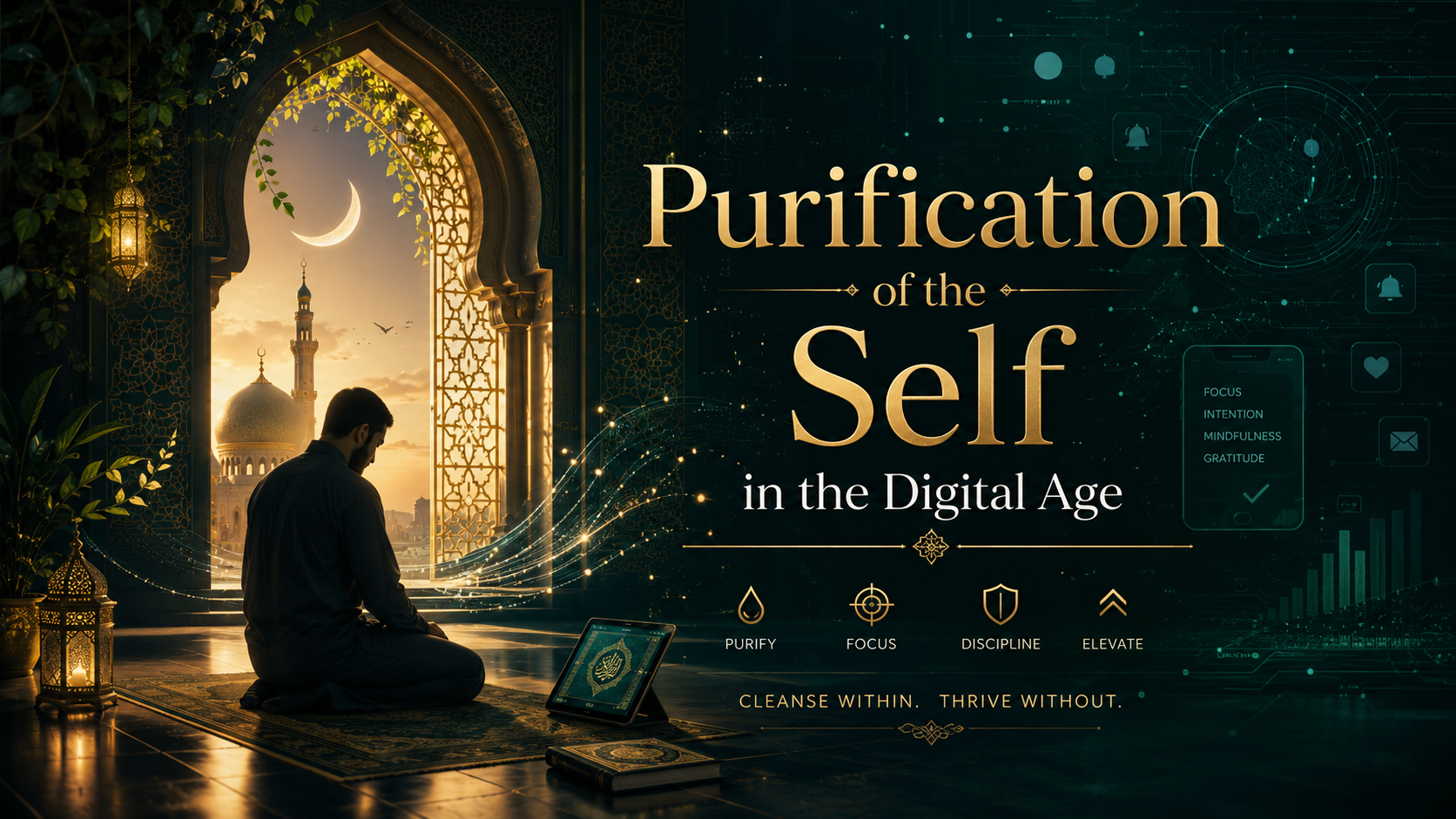
In today’s digital world, the human being is more connected than ever before, yet often more disconnected from their inward and their purpose. Endless scrolling, constant notifications, and the pressure of online presence have quietly shifted attention away from self-reflection and remembrance of Allah. What once required effort to access has now become only a swipe away, making spiritual discipline more necessary than ever before. This is where the concept of purification of the self (Tazkiyah) becomes central.
Purification of the self is not a distant spiritual idea; it is a practical journey of cleansing the inward from envy, pride, distraction, and attachment to anything other than Allah. The Qur’an clearly links success with this purification, and the teachings of Prophet Mohammad emphasize that true reform begins from the inward. When the inward is sound, the entire life becomes balanced. When it is corrupted, everything falls into disorder.
The article also explores how the digital age has created new forms of inner struggle. Today, the battle is not only against visible sins but also against invisible distractions, comparison, and constant exposure to meaningless content. However, this same digital world can also become a means of spiritual growth if used with awareness and discipline. When time, skills, and attention are redirected toward meaningful purpose, even technology can become a path toward self-purification.
Every era in human history has brought new temptations and challenges. However, the digital age of the twenty-first century is unique and perhaps the most complex of all. Today, human beings appear connected to the entire world. Yet, many have become disconnected from their own inward and their Creator.
The flood of the internet, social media, and artificial intelligence (AI) has undoubtedly made life easier. However, it has also placed veils over human perception and inward that seem difficult to remove. Hidden desires behind screens, envy, showing off, and the waste of time are silent destroyers. Consequently, they stand as barriers in the path of self-purification.
In this age, the importance of purification of the self has grown more than ever before. Sin now lies only one scroll away. However, the true purpose of human creation is Divine recognition (Ma‘rifat-e-Ilahi). The only path toward this recognition is the purification of the self.
What Is Purification of the Self (Tazkiyah)?
Linguistically, Tazkiyah means purification, growth, and refinement. In the terminology of Sufism, purification of the self refers to cleansing the self from evils, immoral traits, and attachment to anything other than Allah. As a result, the self becomes prepared for obedience to Allah.
Allah Almighty has also placed human success and failure upon the purification of the self in the Qur’an. It is clearly stated that true success belongs to the one who purifies the self, while failure belongs to the one who buries it beneath sins and corruption.
In the Qur’an, Allah says:
“Indeed, successful is the one who purifies it, and unsuccessful is the one who corrupts it.”
— Al-Shams 91:9–10
“Indeed, successful is the one who has purified oneself.”
— Al-A‘la 87:14
Restraining the Nafs al-Ammarah
Regarding the control of the Nafs al-Ammarah (the self that urges evil), Allah Almighty states:
“And as for the one who feared standing before their Lord and restrained the self from desires, then Paradise alone will surely be their abode.”
— Al-Nazi‘at 79:40–41
One of the central purposes behind the mission of Prophet Mohammad was the purification of the self. Allah Almighty states in the Qur’an:
“Our Lord, send among them a Messenger from among themselves who will recite Your verses to them, teach them the Book and wisdom, and purify them. Surely, You alone are the Almighty, the Most Wise.”
— Al-Baqarah 2:129
Prophet Mohammad said:
“Beware! In the body, there is a piece of flesh. If it becomes sound, the whole body becomes sound. However, if it becomes corrupt, the whole body becomes corrupt. Listen carefully, it is the inward.”
— Sahih al-Bukhari, 52
“The true struggler (Mujahid) is the one who strives against the self in obedience to Allah.”
— Jami‘ al-Tirmidhi, 2459
Spiritual Struggle and Purification of the Self in the Digital Age
In the digital age, this spiritual struggle (jihad) means protecting one’s inward from temptations displayed on screens, the desire for fame and recognition, and meaningless debates that waste time and energy. Today, the battle against the self no longer exists only in physical spaces. Rather, it often unfolds silently through devices, endless scrolling, and constant distractions.
Therefore, purification of the self has become more essential than ever before. A believer must consciously guard the inward from spiritual corruption caused by unhealthy desires, comparison, envy, and digital distractions.
Many saints and spiritual scholars also invited humanity toward self-discipline and purification so that people could attain success before Allah.
Ali Hujwiri states in Kashf al-Mahjub:
“Recognizing the self is the key to Divine recognition. The one who does not purify the self can never reach the Truth.”
According to him, the nafs is like a wild dog that must be restrained through discipline and spiritual effort.
Similarly, Al-Ghazali explains in Ihya Ulum al-Din that the inward resembles a mirror, while sins gather upon it like smoke or rust. As a result, spiritual clarity fades unless the mirror is cleansed through repentance and remembrance of Allah.
Likewise, Sultan Bahoo mentions in Ain-ul-Faqr:
“The Nafs al-Ammarah cannot be defeated by the sword. It can only be overcome through the Divine manifestation of the Name of Allah.”
According to him, the self resembles a Pharaoh that bows only before Divine light. Consequently, true purification comes not through outward force alone, but through spiritual transformation and closeness to Allah.
Lessons in Self-Purification: Self-Accountability and Inner Discipline
The lives of righteous people offer valuable lessons in purification of the self. Their examples teach that spiritual success begins with self-accountability and sincere reflection.
Once, Umar ibn al-Khattab was passing through the marketplace. He heard a man speaking to himself:
“O Umar! You have become the Leader of the Believers. However, if you do not fear Allah, He will hold you accountable severely.”
In reality, it was Umar himself reminding and warning his own self. He was holding himself accountable despite his great status and leadership. He also said:
“Take account of yourselves before you are taken to account.”
This teaching, mentioned in Ihya Ulum al-Din, highlights a fundamental principle of purification of the self. The true path of spiritual refinement begins when a person honestly evaluates personal actions, intentions, and weaknesses.
Therefore, the essence of self-purification lies in regular self-examination. A person must control desires, recognize personal faults, and strive to improve before standing accountable before Allah. In the digital age especially, self-accountability becomes essential because distractions and temptations are constant and immediate.
Junayd of Baghdad was once training his disciples in spiritual discipline and purification of the self. One day, he gave a disciple a bowl filled with milk or oil and said:
“Carry this bowl and walk through the city. However, make sure not even a single drop spills.”
At the same time, another person carrying a sword was instructed to walk behind him. The warning was clear: if his attention drifted and the milk spilled, he would face punishment. When the disciple returned, Junayd asked him:
“What did you see on the way?”
The disciple replied:
“I do not remember anything. I remained completely focused on protecting the bowl.”
Upon hearing this, Junayd explained:
“This is purification of the self. When a person’s inward becomes so focused on Allah that nothing in the world distracts them, true spiritual refinement begins.”
— Al-Risalah al-Qushayriyyah
Meaning of Tazkiyah in the Modern Context
Purification of the self (Tazkiyah) means that a person holds their attention in such a controlled and disciplined way that even while living among the attractions and colors of the world, the inward remains connected to Allah and is not heedless of Him.
Just as the Companions attained purification through the companionship of Prophet Mohammad, in the present era spiritual training is also understood through continued guidance and inner discipline.
In today’s time, within the tradition of Silsila Sarwari Qadri, the thirty-first spiritual guide and the current Imam, Sultan Mohammad Najib-ur-Rehman, has presented the classical understanding of purification of the self in a way that aligns with the needs and challenges of the modern world.
He explains that through complete spiritual attention, inner sight, and pure companionship, the rusted and hardened hearts are refined and purified. As a result, the self becomes cleansed, the inward becomes alive, and a person is able to worship Allah with true understanding and sincerity.
Thus, purification of the self is not only a historical concept, but a continuous spiritual process that remains relevant in every era, especially in a time full of distractions and digital noise.
Modern Guidance for Purification of the Self
In the present era, Sultan ul Ashiqeen’s writings and teachings serve as a guiding light for humanity. Works such as Tazkiyah-e-Nafs ka Nabawi Tareeqa, Shams-ul-Fuqara, Haqeeqat-e-Namaz, Haqeeqat-e-Rozah, Haqeeqat-e-Zakat, and Haqeeqat-e-Hajj act as a source of direction. These teachings call wandering humanity back toward the straight path (Sirat al-Mustaqeem) and true servitude to Allah.
In today’s restless and distraction-filled age, people often do not have the time for long periods of seclusion or intense physical spiritual exercises. Therefore, a simpler yet deeply effective method of purification has been emphasized: the remembrance of the Divine Name (Ism-e-Allah Zaat) and inward contemplation. This practice is presented as one of the most powerful means of cleansing the self.
Within these teachings, the core principle is expressed as:
“Allah alone is sufficient; everything other than Allah is temporary.”
This reflects a complete turning of the inward toward Divine presence, detaching from all forms of dependence and distraction.
Furthermore, the remembrance of Ism-e-Allah Zaat and its contemplation has been made widely accessible, so that spiritual purification is no longer limited to extreme isolation or difficult practices. Instead, it becomes a continuous inward connection with Allah in everyday life.
Along with this, the practice of Zikr-e-Ya Hoo is also encouraged as a direct nourishment for the inward. It is described as spiritual food for the soul, helping a person remain alive inwardly and connected to Divine reality despite external distractions.
Purification of the Self Through Digital Responsibility
Sultan Mohammad Najib-ur-Rehman has also taught that modern digital media can be used as a means of purification of the self. Through the platform of Tehreek Dawat-e-Faqr, digital and social media have been transformed into tools for spreading religious awareness and inner reform.
In this approach, disciples are often assigned constructive responsibilities such as web design and development, video creation and editing, and social media management. These tasks are not merely professional activities. Rather, they represent a form of spiritual discipline and self-sacrifice.
When a disciple dedicates their time, energy, and skills for the sake of Allah, the process of purification of the self begins. In this way, the self is trained to prioritize purpose over personal desire. Consequently, discipline, focus, and sincerity gradually develop within the inward.
At the same time, these responsibilities also equip a person with practical skills. In the context of the modern world, such skills can become a lawful means of earning, allowing a balance between spiritual growth and worldly responsibility.
The digital age, therefore, is not only a time of trial but also an opportunity for closeness to Allah—provided a person remains guided by spiritual principles. If the reins of the self are placed under the discipline of Shariah and spiritual training, then technology becomes a means of elevation rather than distraction.
Purification of the self is not a final destination but a continuous journey that lasts until death. It is a process of constant refinement, awareness, and struggle against inner negligence.
Sultan Mohammad Najib-ur-Rehman has also explained that just as good and evil exist within human nature, they also exist within human inventions. Therefore, one should avoid the harmful use of technology and adopt its beneficial aspects instead.
Ultimately, the need of the time is to avoid becoming a slave to technology and instead use it as a tool for spiritual purpose. These teachings emphasize that even while living in the modern world, a person can keep the inward illuminated with the remembrance of Allah and remain engaged in meaningful, purposeful living.
Questions Answered in This Article:
- What is the meaning and importance of purification of the self in the digital age?
- How can modern technology be used for spiritual growth and self-purification?
How useful was this post?
Click on a star to rate it!
Average rating 5 / 5. Vote count: 1
No votes so far! Be the first to rate this post.



Leave a Reply