
Allah Almighty states:
وَإِذْ غَدَوْتَ مِنْ أَهْلِكَ تُبَوِّئُ الْمُؤْمِنِينَ مَقَاعِدَ الْقِتَالِ وَاللهُ سَمِيعٌ عَلِيمٌ
“And (remember) when you (O Beloved ﷺ) set out from your home in the early morning, assigning the believers to their positions for battle, and Allah is All-Hearing, All-Knowing.” (3: 121)
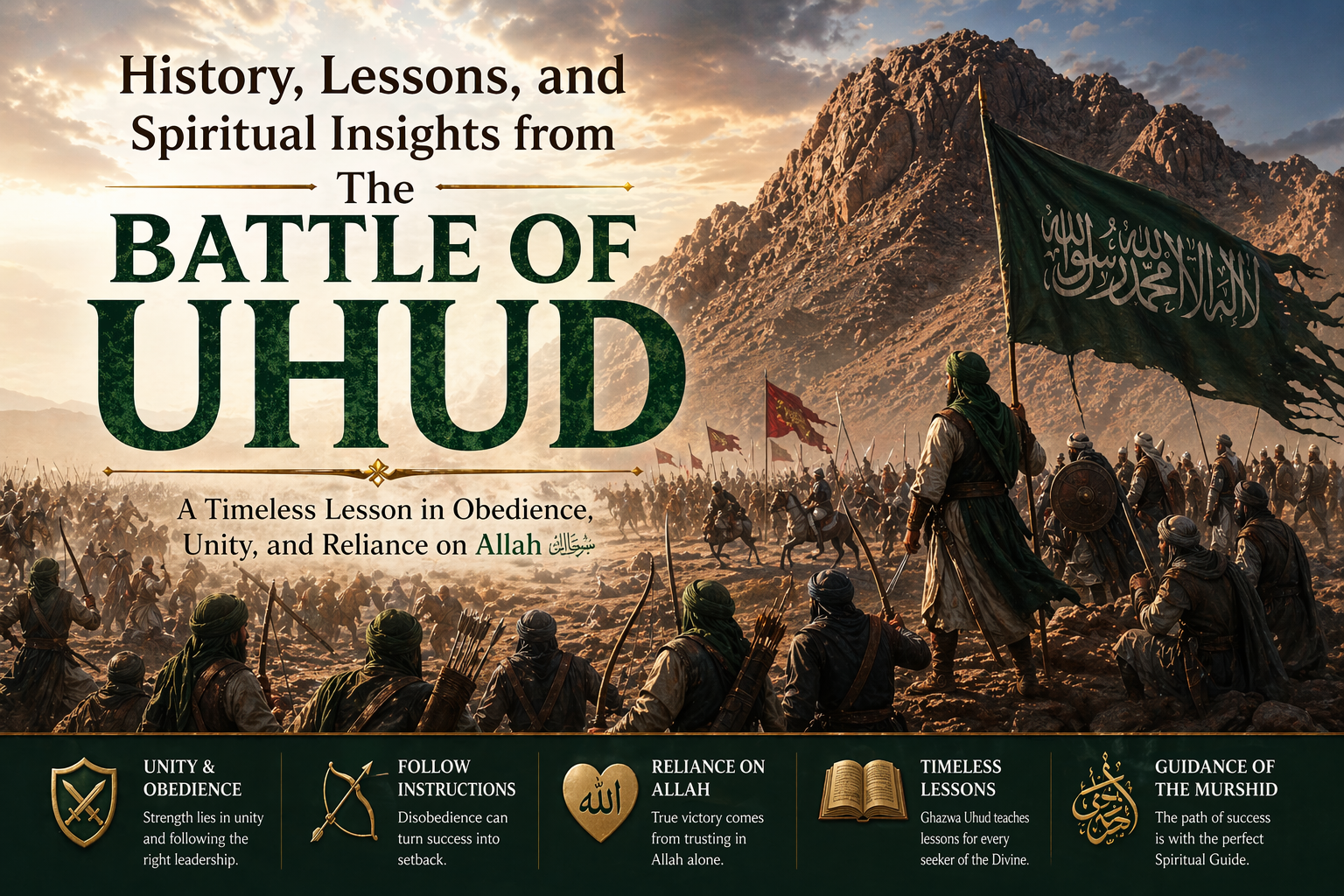
The above verse points to the Battle of Uhud, which was the second major battle in Islamic history. This battle ended without a decisive result, and the Muslims faced considerable difficulties. The Battle of Uhud took place in Shawwal, 3 Hijri, in a field located behind Mount Uhud.
Background
The disbelievers were deeply grieved after their defeat in the Battle of Badr. The defeat, humiliation, and loss of their leaders filled them with anger against the Muslims. After Badr, they collectively decided to wage a full-scale war against the Muslims to avenge their losses and satisfy their rage. Preparations for war began immediately.
Among the leaders of Quraysh, Ikrimah bin Abu Jahl, Safwan bin Umayyah, Abu Sufyan, Harb, and Abdullah bin Abi Rabiah were especially enthusiastic and took the lead.
Preparations of the People of Makkah
The Quraysh first decided to use the wealth of Abu Sufyan’s trade caravan that was saved during the events leading to Badr for war expenses. They addressed the people saying:
“O people of Quraysh! Mohammad has struck you severely and killed your noble leaders. Therefore, support the war against him with your wealth so that we may take revenge.”
The people agreed. The entire wealth, amounting to one thousand camels and fifty thousand dinars, was sold to fund the war. Volunteers were recruited, and poetry was used to ignite passion and honour among the people.
A poet named Abu Azza, who had been captured at Badr and later released by the Holy Prophet (pbuh) on the condition that he would not oppose him again, was incited by Safwan bin Umayyah to provoke tribes against the Muslims. He broke his promise and began stirring emotions against the Muslims.
Women also played a role. Hind, the wife of Abu Sufyan, organised gatherings where poetry was recited to encourage participation in the war. Women even donated their jewellery for war preparations.
The Quraysh Army and War Equipment
After a year of preparation, the Quraysh assembled an army of three thousand men. It was agreed that women would accompany them to maintain a sense of honour and motivation. Fifteen women joined the expedition, including Hind.
The army was led by Abu Sufyan.
News Reaches Madinah and Emergency Measures
The Prophet’s uncle, Abbas (RA), closely observed these developments and sent detailed information through a letter. It was read to the Holy Prophet by Ubayy bin Kaab, and he was instructed to keep it confidential.
A state of alert was declared in Madinah. People remained armed at all times, even during prayers. A group including Saad bin Muadh, Usayd bin Hudayr, and Saad bin Ubadah was assigned to guard the Holy Prophet, spending nights at his door in full readiness.
This practice of the Companions is a lesson for seekers of Allah: that one should be ready to sacrifice everything for the protection of a perfect spiritual guide who follows the path of the Holy Prophet.
Consultation (Shura) for Defence Strategy
In light of the situation, the Holy Prophet convened a council and shared a dream. He said that he saw cows being slaughtered, a defect in the tip of his sword, and that he placed his hand in a strong armour.
He interpreted this as: someone from his household would be martyred, and the strong armour represented the city of Madinah.
Consultation with the Companions and Abdullah bin Ubayy
The Holy Prophet consulted both the Muhajirun and Ansar. Abdullah bin Ubayy, the leader of the hypocrites, was also invited for the first time.
Many companions suggested remaining inside Madinah and fighting defensively. This was also the opinion of Abdullah bin Ubayy, though his intention was to avoid battle.
However, some companions who had missed Badr strongly urged fighting in the open field. Among them was Hamzah bin Abdul Muttalib (RA). Eventually, the Holy Prophet wore his armour and prepared for battle, signalling the decision to fight outside.
Arrangement of the Muslim Army
The Holy Prophet divided the army into three groups:
- Muhajirun – flag given to Musab bin Umayr
- Aws (Ansar) – flag given to Usayd bin Hudayr
- Khazraj (Ansar) – flag given to Hubab bin Mundhir
The Muslim army consisted of one thousand men, including one hundred armoured soldiers and fifty cavalries. Ibn Umm Maktum was appointed to lead prayers in Madinah.
Night Between Uhud and Madinah
The army camped at a place called Shaykhan between Uhud and Madinah. Fifty companions were assigned for night patrol under Mohammad bin Maslamah.
The Withdrawal of Abdullah bin Ubayy
Before dawn, the army moved forward and prayed Fajr at Ashwat. At this point, Abdullah bin Ubayy withdrew with three hundred men, claiming his opinion had not been followed.
This act caused unrest and aimed to weaken Muslim morale while strengthening the enemy’s confidence.
The Quran refers to such hypocrites as:
وَ لِیَعْلَمَ الَّذِیْنَ نَافَقُوْا ۖۚ وَ قِیْلَ لَهُمْ تَعَالَوْا قَاتِلُوْا فِیْ سَبِیْلِ اللّٰهِ اَوِ ادْفَعُوْا ؕ قَالُوْا لَوْ نَعْلَمُ قِتَالًا لَّا تَّبَعْنٰكُمْ ؕ هُمْ لِلْكُفْرِ یَوْمَىِٕذٍ اَقْرَبُ مِنْهُمْ لِلْاِیْمَانِ ۚ یَقُوْلُوْنَ بِاَفْوَاهِهِمْ مَّا لَیْسَ فِیْ قُلُوْبِهِمْ ؕ وَ اللّٰهُ اَعْلَمُ بِمَا یَكْتُمُوْنَۚ
And that He may (also) expose the hypocrites. (When) it was said to them: ‘Come (now), fight in the way of Allah or (at least) defend (yourselves against the enemy invasion),’ they said: ‘If only we knew how to fight (or if we considered it a fighting in the cause of Allah), we would certainly have followed you.’ That day, they were closer to disbelief than to (their pretend) belief. They utter from their mouths what is not in their hearts. And Allah knows best whatever they conceal. (3: 167)
After this, the Muslim army was reduced to 700 men.
Defensive Strategy
The Holy Prophet positioned the army with Mount Uhud behind them and the enemy in front. A vulnerable pass was identified, and fifty archers were placed there under Abdullah bin Jubayr.
They were strictly instructed not to leave their position under any circumstances.
Beginning of the Battle
The battle began with single combat. Talhah bin Abi Talhah from the Quraysh was killed by Zubayr (RA). Then full fighting broke out.
Hamzah (RA) displayed great bravery, and the Muslims initially gained the upper hand. The archers successfully held back the enemy cavalry led by Khalid bin Walid (who had not yet accepted Islam).
The Quraysh began to retreat.
The Mistake of the Archers
As the enemy fled, Muslims began collecting war spoils. Seeing this, most of the archers left their post despite clear instructions.
Only Abdullah bin Jubayr and a few others remained.
Sudden Counterattack
Khalid bin Walid seized the opportunity, attacked from behind, and turned the tide. The Muslims were surrounded, and chaos spread.
A rumour spread that the Holy Prophet had been martyred (God forbid), causing panic. In reality, Musab bin Umayr (RA), who resembled the Holy Prophet, had been martyred.
Some companions lost heart, while others fought with even greater determination.
Eventually, Kaab bin Malik (RA) saw the Holy Prophet alive and announced it. The Muslims regrouped and surrounded him.
Outcome and Reflection
Initially, the Muslims relied partly on their numbers and preparation. The temporary setback served as a lesson. When they regrouped, Allah granted them success.
Seventy companions were martyred, including Hamzah (RA). The enemy mutilated the bodies, and Hind desecrated Hamzah’s body, which deeply grieved the Holy Prophet.
Spiritual Lesson
The incident of the archers teaches seekers of truth the importance of obedience to their spiritual guide. Every instruction carries hidden wisdom.
A true seeker must follow the Spiritual Guide completely, even when it appears difficult.
Final Reflection
Allah has granted us access to a perfect spiritual guide in this era in the form of Sultan-ul-Ashiqeen Sultan Mohammad Najib-ur-Rehman.
May Allah grant us the ability to live with true love and obedience to our spiritual guide. (Ameen)
Question: What happened at the Battle of Uhud?
The Battle of Uhud was fought near Mount Uhud after the Quraysh, led by Abu Sufyan, sought revenge for Badr. The Holy Prophet (pbuh) led 1,000 Muslims, but Abdullah bin Ubayy (the hypocrite) withdrew with 300, leaving 700. Fifty archers under Abdullah bin Jubayr were told not to leave their post.
Muslims initially gained the upper hand, but when many archers left their position, Khalid ibn al-Walid attacked from behind. Chaos followed, and about 70 companions, including Hamzah ibn Abdul-Muttalib (RA), were martyred. There is a lesson for the seekers of Divine that relying on material strength instead of trust in Allah leads to setback.
How useful was this post?
Click on a star to rate it!
Average rating 4.6 / 5. Vote count: 8
No votes so far! Be the first to rate this post.



Comments (15)
Great article. Thanks for sharing.
Great
nice article
Great Article.
Great article
Very Informative
informative article
relying on material strength instead of trust in Allah leads to setback.
The Muslim army consisted of one thousand men, including one hundred armoured soldiers and fifty cavalries. Ibn Umm Maktum was appointed to lead prayers in Madinah.
really amazing content
A true seeker must follow the Spiritual Guide completely, even when it appears difficult.
best article
A true seeker must follow the Spiritual Guide completely, even when it appears difficult
Very impressive article
May Allah grant us the ability to live with true love and obedience to our spiritual guide. (Ameen)